
Introduction
Generating leads has long been considered the primary goal of B2B marketing. However, many businesses discover that a growing list of leads does not automatically translate into increased revenue. Marketing teams often invest heavily in content creation, paid advertising, social media campaigns, email marketing, and lead generation initiatives, only to find that sales pipelines remain weak and conversions stay low.
The problem is not always the amount of effort being invested. In many cases, the issue lies in the strategy itself. Too many companies focus on vanity metrics such as website traffic, social media engagement, impressions, downloads, and Marketing Qualified Leads (MQLs) without measuring their impact on revenue.
Modern B2B marketing requires a different mindset. Success is no longer about reaching the largest audience possible. Instead, it is about identifying the right companies, understanding their challenges, building trust with decision-makers, and creating a predictable pipeline of qualified opportunities.
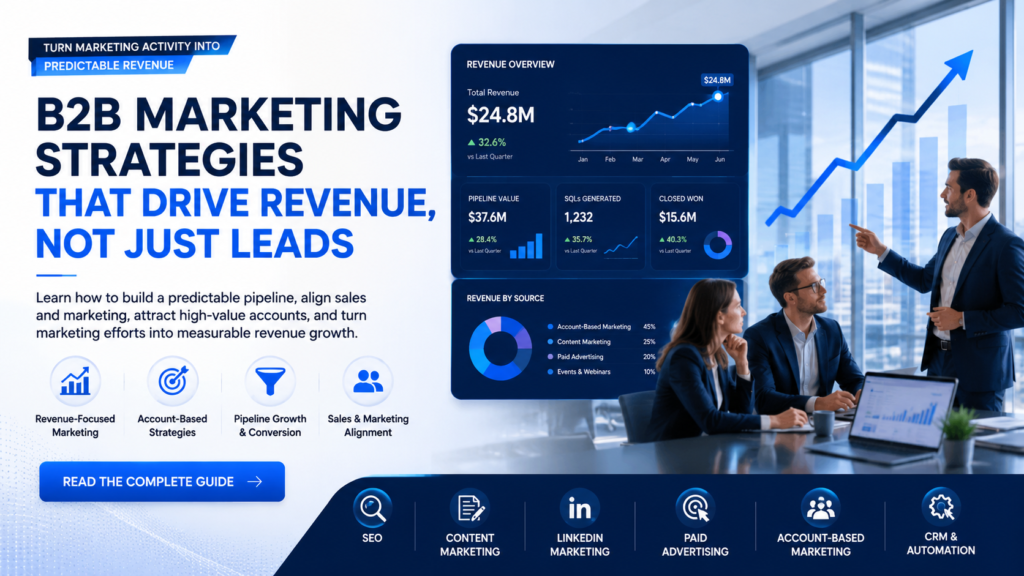
Why Most B2B Marketing Fails to Generate Revenue
One of the biggest mistakes companies make is treating B2B marketing like B2C marketing.
Business-to-consumer marketing often focuses on reaching large audiences through awareness campaigns, influencer partnerships, viral content, and mass advertising. These approaches can work because consumer purchases are often emotional, individual, and relatively quick.
B2B buying behavior is completely different.
Business purchases typically involve:
- Multiple decision-makers
- Longer buying cycles
- Higher investment amounts
- Greater risk assessment
- Internal approvals and discussions
A company may take weeks or even months to evaluate a solution before making a purchase decision.
As a result, generating large numbers of leads is not enough. Businesses must focus on influencing the right buyers at the right stage of their decision-making process.
The key question should not be:
“How do we get more leads?”
Instead, ask:
“How do we generate more qualified opportunities that become revenue?”
This shift in perspective changes every aspect of your marketing strategy.
- Define a Narrow and Revenue-Focused Ideal Customer Profile (ICP)
A well-defined Ideal Customer Profile is the foundation of successful B2B marketing.
Many organizations make the mistake of targeting broad market segments such as:
- SaaS companies
- Manufacturing businesses
- Mid-sized enterprises
- Healthcare organizations
These descriptions are too broad to create effective marketing campaigns.
A strong ICP should include:
Industry
Identify the specific industries that benefit most from your product or service.
Company Size
Define employee count and revenue range.
Geographic Location
Focus on regions where your solution is most relevant.
Business Stage
Consider startup, growth-stage, enterprise, or mature organizations.
Technology Stack
Understand the tools and systems prospects already use.
Buying Committee
Identify who influences purchasing decisions.
Pain Points
Clearly define the business problems your solution solves.
Budget Readiness
Determine whether the organization can realistically invest in your offering.
The more precise your ICP becomes, the easier it is to create messaging that resonates and generates high-quality opportunities.
- Stop Measuring Vanity Metrics and Focus on Pipeline
Many marketing teams celebrate metrics that have little connection to revenue.
Common vanity metrics include:
- Website traffic
- Social media likes
- Post impressions
- Content downloads
- Email open rates
- Webinar registrations
While these metrics can indicate engagement, they do not necessarily contribute to business growth.
Revenue-focused marketing teams prioritize metrics such as:
Marketing-Sourced Pipeline
Opportunities directly generated by marketing efforts.
Marketing-Influenced Pipeline
Deals where marketing contributed to the buyer’s journey.
Sales Qualified Opportunities
Leads approved by sales teams for active pursuit.
Opportunity Conversion Rate
Percentage of opportunities that progress through the sales process.
Pipeline Velocity
Speed at which prospects move through the funnel.
Revenue Attribution
Revenue influenced or generated by marketing activities.
By focusing on pipeline metrics, marketing teams become more accountable and better aligned with business goals.
- Build Content Around Buyer Questions
Content marketing remains one of the most effective B2B marketing strategies.
However, publishing content simply for the sake of publishing rarely produces meaningful results.
Many companies create large amounts of generic content that attracts visitors but fails to convert them into buyers.
The most effective content answers questions that buyers are already asking.
Talk to your sales team and identify:
- Common objections
- Frequently asked questions
- Comparison requests
- Budget concerns
- Implementation challenges
- Vendor evaluation criteria
These insights provide valuable content opportunities.
Examples include:
- How to Choose the Right CRM for Manufacturing Companies
- Why Your Lead Generation Campaigns Are Not Producing Revenue
- SEO vs Paid Advertising for B2B Growth
- How to Calculate Marketing ROI
- Common Mistakes in Digital Transformation Projects
Content that directly addresses buyer concerns supports both marketing and sales efforts.
- Adopt an Account-Based Marketing Approach
Traditional marketing focuses on attracting broad audiences.
Revenue-focused B2B marketing focuses on high-value accounts.
Account-Based Marketing (ABM) helps businesses prioritize specific organizations that match their ideal customer profile.
Instead of targeting thousands of anonymous prospects, ABM focuses resources on companies with the highest potential value.
Benefits of ABM include:
- Higher conversion rates
- Better personalization
- Improved sales alignment
- More efficient budget allocation
- Increased deal sizes
Successful ABM campaigns often involve:
- Personalized email outreach
- Industry-specific content
- Targeted advertising
- Executive engagement
- Customized landing pages
By focusing on accounts instead of audiences, businesses can generate stronger pipeline opportunities.
- Align Marketing and Sales Teams
Sales and marketing alignment is critical for revenue generation.
Unfortunately, many organizations operate with disconnected teams.
Marketing generates leads.
Sales attempts to convert them.
Neither team shares enough information to improve performance.
Revenue-focused companies create ongoing collaboration between sales and marketing.
Marketing should understand:
- Common sales objections
- High-converting customer segments
- Competitive challenges
- Buying behaviors
- Successful sales conversations
Sales should understand:
- Active campaigns
- Target account lists
- Content assets
- Lead nurturing strategies
- Marketing messaging
Regular communication creates a feedback loop that improves both lead quality and sales effectiveness.
- Invest in High-Intent Marketing Channels
Not all marketing channels produce equal results.
Many companies chase trends while ignoring proven revenue-generating channels.
Some of the most effective B2B channels include:
Search Engine Optimization (SEO)
SEO helps businesses capture demand from prospects actively searching for solutions.
Paid Search Advertising
Google Ads can generate highly qualified traffic when targeting high-intent keywords.
LinkedIn Marketing
LinkedIn remains one of the most valuable platforms for B2B decision-makers.
Email Nurturing
Strategic email sequences help move prospects through the buying journey.
Customer Referrals
Satisfied customers often become the strongest source of new business.
Webinars
Educational events establish credibility and generate qualified leads.
Retargeting Campaigns
Retargeting keeps your brand visible to interested prospects.
The goal is not to be everywhere. The goal is to be where your buyers are actively seeking solutions.
- Build Brand Recognition Within Your Target Market
Many B2B organizations underestimate the value of branding.
Branding is not just logos, colors, and design elements.
Brand recognition influences buying decisions.
A prospect may:
- Read your blog today
- Follow your LinkedIn content next month
- Attend your webinar later
- Speak with a customer six months from now
- Contact your sales team when a need arises
Every interaction contributes to trust.
Strong B2B brands invest in:
- Thought leadership
- Educational content
- Industry expertise
- Customer success stories
- Leadership visibility
- Consistent messaging
Brand familiarity often shortens sales cycles and improves conversion rates.
- Create Content for Every Stage of the Buyer Journey
Different buyers require different types of information.
Your content strategy should support every stage of the decision-making process.
Top-of-Funnel Content
Designed to educate and create awareness.
Examples:
- Industry trends
- Educational blogs
- Research reports
- Thought leadership articles
Middle-of-Funnel Content
Designed to help buyers evaluate solutions.
Examples:
- Comparison guides
- Case studies
- Webinars
- Product explainers
Bottom-of-Funnel Content
Designed to support purchase decisions.
Examples:
- Testimonials
- ROI calculators
- Pricing pages
- Product demonstrations
- Customer success stories
A complete content strategy helps buyers progress naturally through the sales funnel.
- Focus on Customer Retention and Expansion
Revenue generation is not limited to acquiring new customers.
Existing customers often provide the greatest growth opportunities.
Retention strategies include:
- Customer success programs
- Ongoing training
- Product adoption initiatives
- Regular account reviews
- Educational content
Expansion opportunities include:
- Upselling
- Cross-selling
- Additional services
- Long-term contracts
Acquiring a new customer is typically more expensive than retaining an existing one.
Businesses that prioritize customer success often achieve stronger profitability.
- Commit to Consistency Over Growth Hacks
Many organizations constantly switch strategies.
They test a campaign for a few weeks, see limited results, and immediately move on to something else.
This approach prevents long-term success.
B2B buying cycles are lengthy.
Trust takes time to build.
Brand recognition compounds over months and years.
Successful B2B companies remain consistent with:
- Messaging
- Content creation
- SEO investment
- Sales alignment
- Account targeting
- Brand building
Consistency creates momentum.
Momentum creates pipeline.
Pipeline creates revenue.
Building a Revenue-Driven B2B Marketing System
The highest-performing B2B organizations do not rely on isolated tactics.
They build integrated systems.
A revenue-focused marketing system includes:
- Clear ICP definition
- Account-based targeting
- SEO and paid search
- Thought leadership content
- Sales and marketing alignment
- Lead nurturing programs
- Customer success initiatives
- Pipeline tracking
- Brand building
When these components work together, marketing becomes predictable, scalable, and measurable.
Instead of constantly searching for new tactics, organizations create repeatable processes that consistently generate opportunities.
Final Thoughts
B2B marketing is not about generating the highest number of leads.
It is about generating the right opportunities.
The most successful companies focus on quality over quantity, pipeline over vanity metrics, and long-term trust over short-term attention.
If your current marketing efforts are producing activity but not revenue, it may be time to evaluate your strategy.
Ask yourself:
- Is our ICP clearly defined?
- Are we measuring pipeline or just leads?
- Does our content answer real buyer questions?
- Are sales and marketing aligned?
- Are we investing in the right channels?
- Are we building trust within our target market?
- Are we giving our strategies enough time to succeed?
Revenue-driven B2B marketing is not complicated.
It requires focus, consistency, alignment, and a commitment to understanding your buyers.
When these elements come together, marketing becomes more than a lead-generation function—it becomes a predictable driver of business growth and revenue.
FAQ
What are B2B marketing strategies that drive revenue?
These are marketing strategies focused on generating qualified opportunities, pipeline growth, and revenue instead of vanity metrics such as traffic or social engagement.
Why is ICP important in B2B marketing?
A clear ICP improves targeting, messaging, content relevance, campaign efficiency, and sales conversion rates.
What metrics should B2B marketers track?
Key metrics include marketing-sourced pipeline, marketing-influenced pipeline, opportunity conversion rate, sales-qualified opportunities, and revenue attribution.
Does branding matter in B2B marketing?
Yes. Strong brand recognition increases trust, improves conversion rates, shortens sales cycles, and supports long-term growth.
What is the biggest mistake in B2B marketing?
The biggest mistake is focusing on vanity metrics and lead volume without measuring how marketing contributes to pipeline and revenue.